
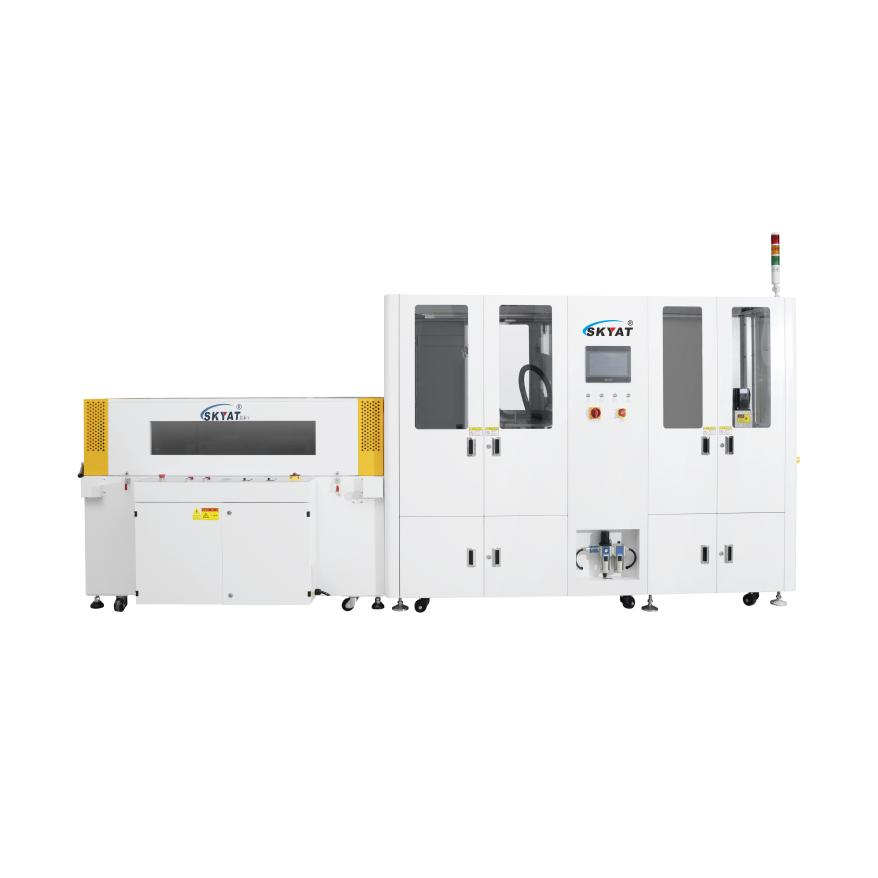
Why Smart Shrink Wrapping Integration Is More Than a Machine Swap
Replacing a conventional shrink wrapper with a smart shrink wrapping system is not a matter of unbolting one machine and sliding another into place. The old machine ran at fixed speed with preset temperature, isolated from the rest of the line. The new system is a networked device — it communicates with upstream conveyors, downstream case packers, and the plant's supervisory control system. Done correctly, integration delivers 40% throughput improvement and 25% energy reduction. Done without planning, it delivers an expensive machine sitting idle while engineers debug communication protocols.
The Connectivity Gap Between Old and New Equipment
The challenge is rarely the shrink wrapper itself — modern machines ship with well-documented PLC interfaces. The challenge is the existing line: a conveyor PLC running firmware from 2012, a line controller using a proprietary protocol, and sensor placements optimized for fixed-speed operation that provide no data useful to a system expecting real-time product dimension input. A smart shrink wrapping system integration must begin with a communication audit: documenting every protocol on the existing line, mapping every I/O point to be shared, and identifying legacy controllers requiring protocol converters or firmware upgrades before the new system can communicate.
Real-World Case — An Electronics Manufacturer Retrofits Mid-Line
An electronics manufacturer in Shenzhen producing consumer devices in retail boxes operated a manual shrink wrap station between an automated cartoner and a case packer. Throughput was capped at 12 boxes per minute by operator speed, and film waste exceeded 20%. The manufacturer integrated a smart shrink wrapping system into the 3.5-meter gap. The frame was custom-configured by SKYAT to fit without relocating the cartoner or case packer. Servo-driven film feed matched each box dimension automatically; multi-zone shrink tunnel temperature adjusted based on real-time product detection. Integration downtime was 36 hours over a weekend. Throughput increased to 22 boxes per minute — an 83% improvement — and film waste dropped below 5%. The IoT module now feeds production data to the plant's MES for real-time visibility into wrap quality, energy consumption, and throughput.
Pre-Integration Assessment
Conveyor Speed, Product Variability, and Space Verification
Three parameters must be documented with real measurements — not layout drawings — before a smart shrink wrapping system arrives. Conveyor speed, measured with a tachometer at the installation point, determines the film feed rate and shrink tunnel dwell time. Product variability — the range of box dimensions across all SKUs — determines whether automatic size-change capability can eliminate manual recipe changes. Actual available space — measured in the plant — determines whether a standard frame fits or custom configuration is required. SKYAT provides pre-integration site assessment to verify these parameters before equipment specification.
The Integration Sequence
Mechanical, Electrical, and Software Handshake
Integration of a smart shrink wrapping system proceeds in four stages. Stage one: mechanical mounting — the frame is positioned, infeed and outfeed conveyors aligned to existing line height and pitch, and the machine leveled and anchored. Stage two: electrical connection — power, compressed air, and the communication cable to the line controller are installed. Stage three: protocol handshake — the system and line controller exchange test signals confirming start/stop, speed sync, and alarm forwarding. Stage four: production ramp — dry-run without film to verify handling, then with film at 50%, 75%, and full speed while operators complete hands-on training. A well-planned integration takes 24 to 72 hours.
IoT-Enabled Benefits After Integration
Real-Time Monitoring, Predictive Alerts, and Energy Optimization
Once integrated, a smart shrink wrapping system contributes data a conventional wrapper cannot. Film usage per package, seal temperature trends, shrink tunnel energy consumption, and throughput rate are logged continuously and accessible via the plant network. Predictive alerts — film roll approaching empty, seal bar heater resistance drift indicating impending failure — allow scheduled maintenance. Energy monitoring across independent heating zones identifies when a zone draws more power than expected, typically indicating failing insulation or a stuck contactor, enabling targeted maintenance that maintains the system's energy efficiency.
Frequently Asked Questions
What is the first step in integrating a smart shrink wrapping system?
The first step is a communication audit — documenting every protocol on the existing line and mapping I/O points between the smart shrink wrapping system and the line controller. SKYAT provides pre-integration site assessment to identify protocol compatibility before equipment specification.
How much downtime is required for integration?
A smart shrink wrapping system integration typically requires 24 to 72 hours — a weekend shutdown — covering mechanical mounting, electrical connection, protocol handshake, and production ramp-up with operator training.
Can a smart shrink wrapper work with legacy conveyors?
Yes, provided the conveyor speed and product pitch are compatible. A smart shrink wrapping system with sensor-based detection adapts to moderate speed variation, but pitch drift above ±5% requires an upstream accumulation buffer.
What throughput improvement is realistic after integration?
A smart shrink wrapping system replacing a manual or semi-automatic station delivers 40% to 80% throughput improvement — gains come from eliminating operator-dependent speed variation and automatic product-size changeover without manual recipe adjustment.
Does smart shrink wrapping reduce energy costs?
Yes. A smart shrink wrapping system with multi-zone PID-controlled heating and automatic standby during line gaps reduces energy consumption by approximately 25% compared to a conventional shrink tunnel running continuously at fixed temperature.
What data does an IoT-enabled smart shrink wrapper provide?
A networked smart shrink wrapping system logs film usage per package, seal temperature trends, energy consumption per zone, and throughput rate. Predictive alerts — low film, heater resistance drift, zone temperature deviation — enable scheduled maintenance and reduce unplanned downtime.