
The Challenge of Irregular Shapes in Automated Packaging
Packaging lines thrive on uniformity. Rectangular boxes and cylindrical containers slide through conveyors and wrappers without friction. The real test begins when a production manager stares at a pile of tapered furniture legs, automotive exhaust pipes, or oddly contoured medical devices and asks one question: can an automatic wrapper actually handle this?
What Makes a Shape “Irregular” for Wrapping?
An irregular item resists predictable mechanical handling. A plumbing elbow joint — one end flared, the other threaded — presents an asymmetric profile. Wooden chair spindles vary slightly after hand-sanding. For an automatic wrapper, irregularity means the film application surface changes constantly as the item rotates. Conventional stretch-wrapping machines assume a consistent cross-section. When that assumption breaks, film either bunches in tight curves, leaves loose flaps in concave areas, or tears at sharp protruding edges.
Common Failure Points in Conventional Systems
Three failure modes dominate irregular-shape packaging. First, film tension inconsistency — preset tension cannot adjust for varying diameters, resulting in loose wraps or crushed protrusions. Second, rotation instability — objects without a stable center of mass wobble mid-cycle. Third, seal failure — uneven surfaces create air pockets that compromise heat-seal integrity.
How Modern Automatic Wrappers Adapt to Non-Standard Items
Sensor Technology and Adaptive Film Tension
Modern automatic wrapper units integrate laser displacement sensors and load cells that continuously measure item profiles. As the product rotates, these sensors feed data to a servo-driven tension control system that adjusts film pull force millisecond by millisecond. A thick section receives firm wrapping force; a fragile section gets gentler treatment. This dynamic adjustment prevents both under-wrapping and product damage.
Multi-Axis Feeding and Adjustable Guide Rails
Advanced automatic wrapper models employ programmable guide rail systems or multi-axis robotic arms that reposition items during wrapping. Rather than forcing an irregular object through a fixed-size ring, the machine actively rotates and shifts the product to present each face optimally to the film web. For tubular items like exhaust pipes, the wrapper follows the bend rather than fighting it. Combined with PLC programming that stores wrapping recipes for different SKU profiles, these systems switch from one irregular shape to another in under a minute without mechanical retooling.
A Practical Case: Wrapping Variable-Sized Industrial Components
A mid-sized manufacturer of hydraulic cylinder components faced a persistent packaging bottleneck. Their product line — cylinder heads, piston rods, and valve bodies — ranged from 6 to 36 inches long with diameters from 2 to 14 inches. The company relied on manual shrink-wrapping with heat guns, employing four full-time workers per shift. Labor costs climbed while a growing order book from automotive clients threatened to outpace wrapping capacity.
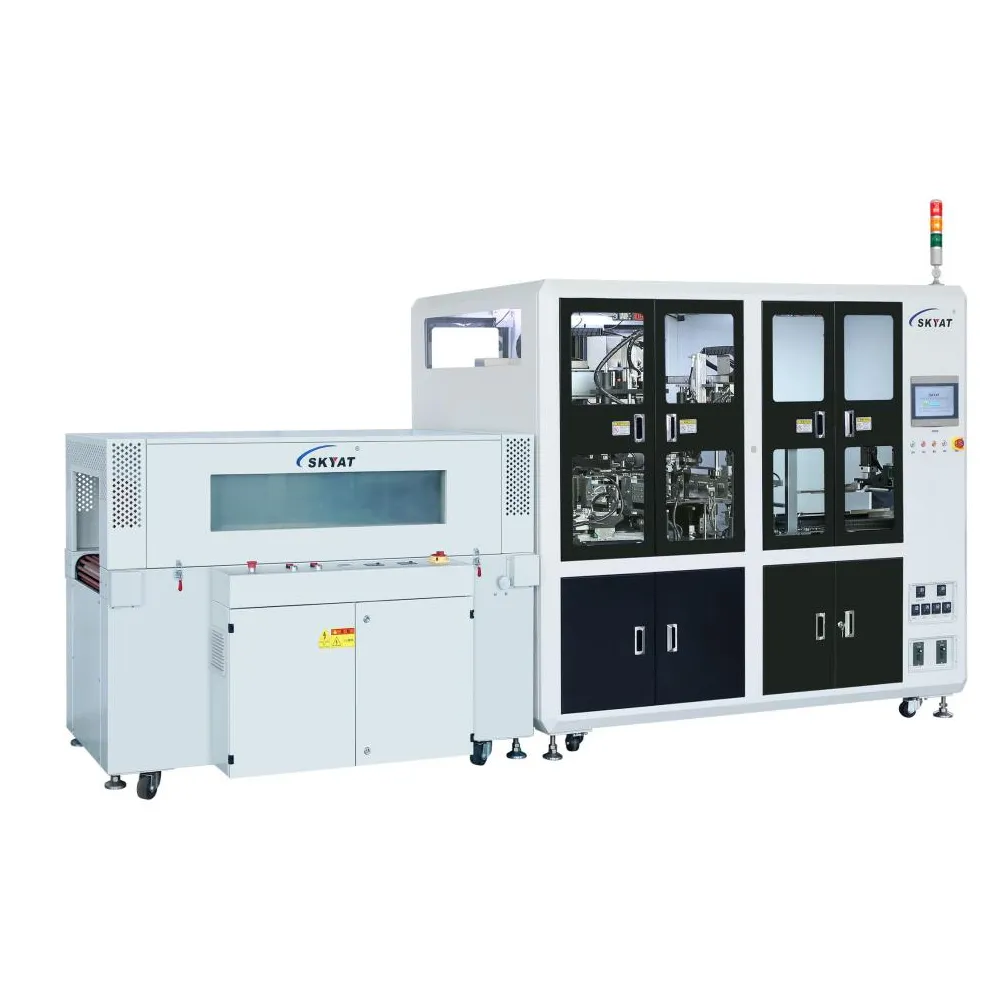
After evaluating several solutions, the manufacturer implemented an automatic wrapper system with adaptive film tension control and programmable guide rails. SKYAT’s engineering team configured the machine with multi-profile recipe storage, allowing operators to select a pre-calibrated wrapping program for each part number. Laser sensors verified part position before each cycle and adjusted film overlap ratios based on item length.
Within three months, wrapping labor dropped from four workers per shift to one operator overseeing the automated line. Film consumption decreased approximately 18% as the adaptive tension system eliminated wasteful extra wrap. Packaging defect rates fell from roughly 7% to under 1%. The bottleneck that had once constrained quarterly output simply disappeared.
Selecting an Automatic Wrapper: Key Considerations
Technical Specifications to Review
Procurement teams should look beyond basic throughput numbers. The tension adjustment range — measured in Newtons — indicates how finely the machine differentiates between fragile and robust sections. Sensor resolution, typically in millimeters or microns, determines accuracy on complex contours. Request test-wrap data on items similar to actual production parts, not standardized rectangular test blocks. NFPA 79 provides guidance on industrial machinery electrical safety when wrappers operate near other equipment.
Maintenance and Operational Best Practices
Sensor calibration should be verified weekly — a drifted laser causes systematic tension errors. Film roll changes offer a chance to inspect the feed path for adhesive buildup, which snags irregular shapes more readily than smooth surfaces. Keep the recipe library current; whenever a new part enters production, run a calibration cycle and save the optimized parameters. Operators should recognize the sound of correct wrapping — a steady hum rather than the straining whine of excessive tension.
Frequently Asked Questions
Can an automatic wrapper handle items with sharp edges?
Sharp-edged items require specialized films with higher puncture resistance. Modern systems from manufacturers like SKYAT accommodate these films, and many include edge-detection sensors that reduce tension near protruding corners. Edge guards or pre-applied corner cushions help with extremely sharp profiles.
What is the maximum size variation an automatic wrapper can manage?
Most advanced automatic wrapper models handle diameter variations up to 300% within a single cycle. The limiting factor is typically film carriage travel range, not the control system. Always consult the manufacturer’s specification sheet for exact dimensional limits.
How does film type affect performance on irregular shapes?
Cast stretch film generally outperforms blown film on irregular shapes — it unwinds more quietly and offers higher cling. For deep concavities, pre-stretched film reduces wrapping force and lowers the risk of crushing delicate sections.
Why do some automatic wrappers require pre-stretch while others do not?
Pre-stretching elongates film before application, increasing yield and reducing cost. It also makes film conform to curves more readily. The trade-off is added mechanical complexity and more frequent roller maintenance.
Which industries see the strongest return from irregular-shape automatic wrapping?
Furniture manufacturing, automotive parts, building materials, and industrial equipment sectors benefit most from automated irregular-shape wrapping. These industries handle mixed-geometry components where manual costs compound quickly.
Do automatic wrappers work with environmentally sensitive packaging films?
Bio-based and recycled-content stretch films work with most modern automatic wrapper systems. Consistent film gauge matters more than material composition. Testing with actual product profiles before full adoption is always recommended.