
On a retail shelf, packaging is the first ad your product ever runs. Set two identical mask gift boxes side by side — one hand-wrapped with creased film and puffed corners, one machine-shrunk to a mirror-flat finish — and most shoppers assume the second one costs more and comes from a more trustworthy brand.
That gap is not cosmetic. It is a revenue problem. For cosmetics, 3C accessories, tea, liquor, and health products — high-margin categories where looks drive price — packaging consistency decides whether the brand premium actually shows up on the shelf.
This guide is for production managers and buyers who are weighing whether to add a shrink wrapping machine for boxes to their line. It follows the real decision path: how the machine works, which wrap styles exist, which film to buy, what the cost model looks like, where buyers get trapped, and the questions to ask every supplier.
Here is the short answer up front. If your product ships in a rigid printed carton and you need retail-shelf flatness, the corner-cut automatic route is the option to evaluate first in 2026. The reasoning follows, with numbers.
Heat shrink wrapping follows one physical logic on every brand of machine. Four steps:
Many buyers ask "how much" before they ask "which type." That is the wrong order. The wrap style sets the machine class, and the machine class sets the price.
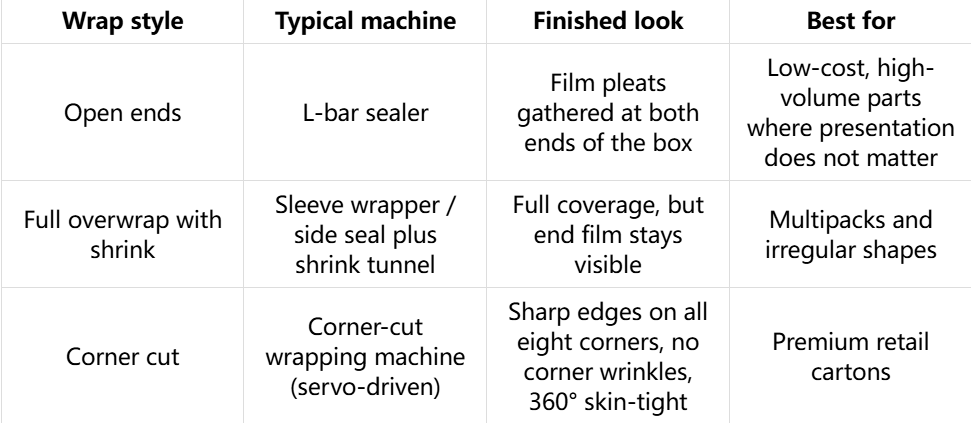
One point separates this guide from the crowd. For the past decade, "automatic shrink wrapping" in Western markets has meant an L-bar sealer plus a shrink tunnel. Chinese supply chains, however, refined four-corner cutting while serving clients like Apple and Huawei — buyers with near-obsessive standards for packaging finish.
That process know-how has since spread into beauty, tea gifts, and health products, and global brands now treat it as a genuine edge. Few English-language buyer guides explain the technology clearly. This guide exists to close that gap.
Corner-cut machines ship with two main sealing routes. Middle-seal models run one seal line across the middle of the box face. Hidden-line models tuck the seal to the box edge or bottom, so the front face shows no trace of the seal. Brands that want a completely clean front panel should look at hidden-line machines.
The machine is the means; the spreadsheet is the point. No matter which automatic shrink wrap machine you price out, evaluate it on three numbers first.
Yield. Film grade, temperature, and blade condition all create rejects. Skyat corner-cut machines carry a stated production yield of ≥98–99%. That figure is not marketing copy. It comes from blade temperature control (150–230°C, adjustable) plus the repeat accuracy of servo positioning.
Yield loss is quiet money. At 5,000 boxes a day, every percentage point you give up is 50 scrapped boxes a day — about 12,000 units a year of avoidable loss.
The film decides optics, compliance, and cost. No shrink wrapping machine for boxes performs well on the wrong film. Corner-cut machines pair best with POF (polyolefin) shrink film.
When you shortlist suppliers, ask for food-contact certification documents for the film. Then test two film thicknesses on your largest SKU and compare corner shrink and haze side by side.
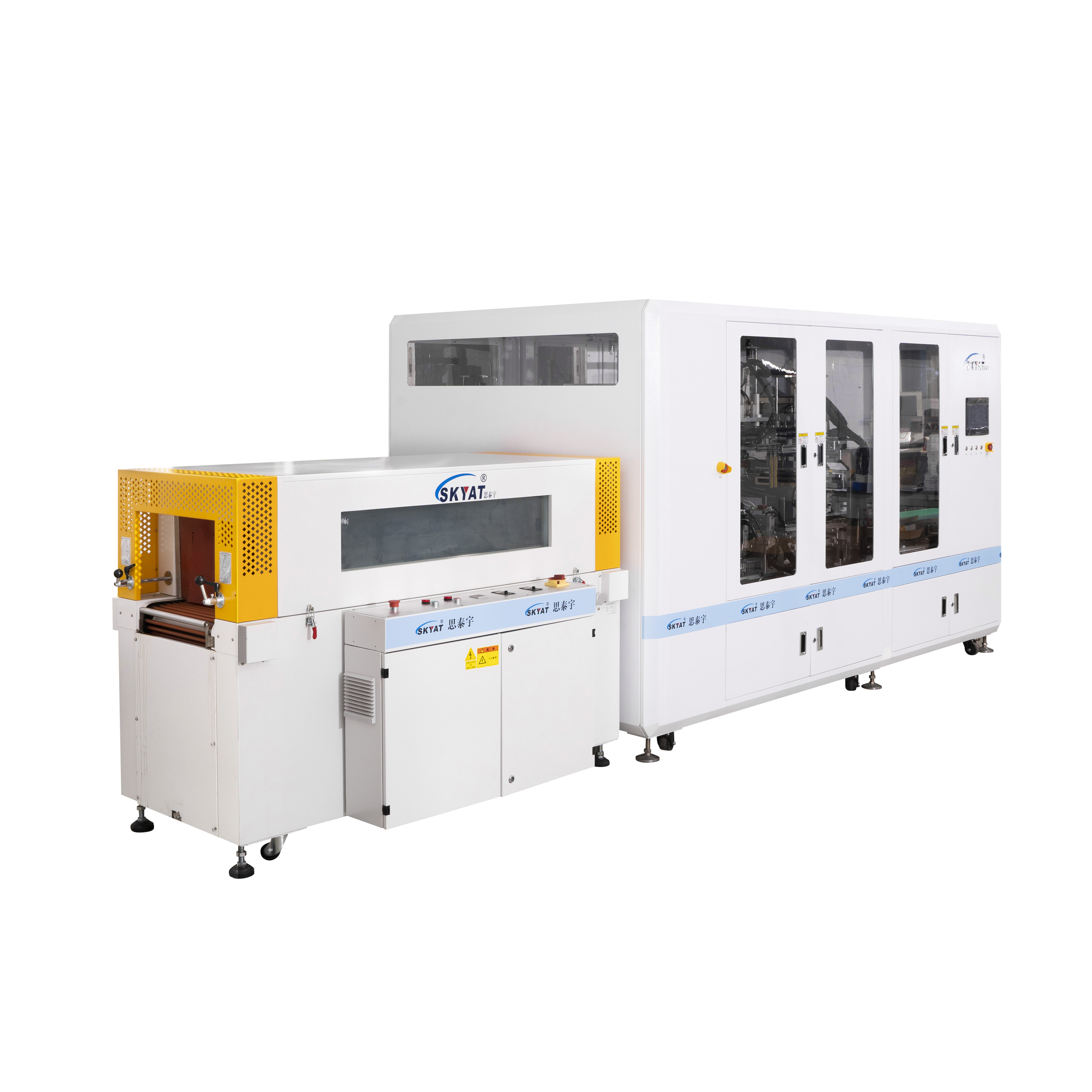
Placeholder image — replace with real SKYAT sample photos before publish.
A cheap machine looks almost identical to a premium one in the brochure photo. The difference shows up after you open the panels.
Trap 1: Downgraded cutting blades. Corner cutting lives or dies on the blade. A SKD11-grade cutter lasts several times longer than ordinary tool steel, and the downtime cost of blade changes dwarfs the price difference.
Trap 2: Temperature control in name only. Unstable seal temperatures cause cold welds and melt-through, and yield collapses. Ask for the control accuracy and the heating method in writing.
Trap 3: Off-brand core components. Ball screws (HIWIN), cylinders and valves (AIRTAC), and photoelectric sensors (OMRON or Panasonic) are not in the same world as unbranded parts. Component choice decides whether mean time between failures really clears 5,000 hours.
Trap 4: Wrench-based changeover. Non-servo machines need 30 minutes or more of manual adjustment for every new size. Multi-SKU orders will strangle a line that slow.
Trap 5: After-sales in name only. If the builder sits 8,000 km away, pin down response time, spare-parts stock, and remote diagnostics before you sign. Remote monitoring and failure alerts are standard equipment expectations in 2026.
Trap 6: A machine, not a system. Feeding, conveying, discharge, and line-speed matching need a supplier that can engineer the whole line. A builder that only drops a single wrapper on your floor leaves the risk with you.
Copy these eight questions straight into your RFQ email. They will filter out most unreliable quotes:
Q1: We wrap fewer than 1,000 boxes a day. Do we need an automatic machine?
1,000 boxes a day is the natural cutoff. Below it, start with a semi-automatic L-bar sealer to prove the process. Above it, evaluate a fully automatic corner-cut machine — labor savings typically close the price gap with a manual line within one year.
Q2: How much more does a corner-cut machine cost than an L-bar sealer?
Corner-cut machines add a servo corner-cutting module, so they list a price tier higher. If you buy a shrink wrap machine for boxes destined for retail shelves, the yield and presentation gains usually pay that difference back in 12–18 months.
Q3: POF or PVC film?
Export markets and food or cosmetics products should use POF. PVC only makes sense for ultra-low-cost domestic channels, and only after you accept the environmental-compliance risk.
Q4: Will the machine connect to our existing line?
Integratable models link to upstream box feeders and downstream case packers for 24-hour production. State your line speed in the RFQ so the supplier can match the conveyor cadence.
Q5: One machine running many sizes — will it break down often?
Machines that change over with servo recipes instead of mechanical hard stops fail measurably less often. The brand of core components sets the uptime ceiling.
Q6: Is sample testing free?
Mainstream builders, including Skyat, offer free test wrapping. Send 3–5 boxes that represent your range and ask for the test video in return.
Packaging is your product's first advertisement, and a corner-cut shrink wrapping machine for boxes is the automation that lets that ad run perfectly every single day. Stop betting your brand's shelf presence on the mood and fatigue level of a hand-wrapping crew.
Next step: send 3–5 of your most typical boxes to Skyat (or any shortlisted supplier) for a free sample run. Compare four-corner flatness, film haze, and overall hand feel in the test video. Let the sample make the decision for you.
→ Get a Quote / Book a Free Sample Test
Machine terminology and industry benchmarks in this guide follow usage at the PMMI — Association for Packaging and Processing Technologies and the World Packaging Organisation. Production figures (650–1,200 UPH, ≥98–99% yield, −40% energy) are SKYAT product-spec values; confirm wording with the factory engineer before publishing.
Copyright © 2025 By Skyat Limited. - Privacy policy
